
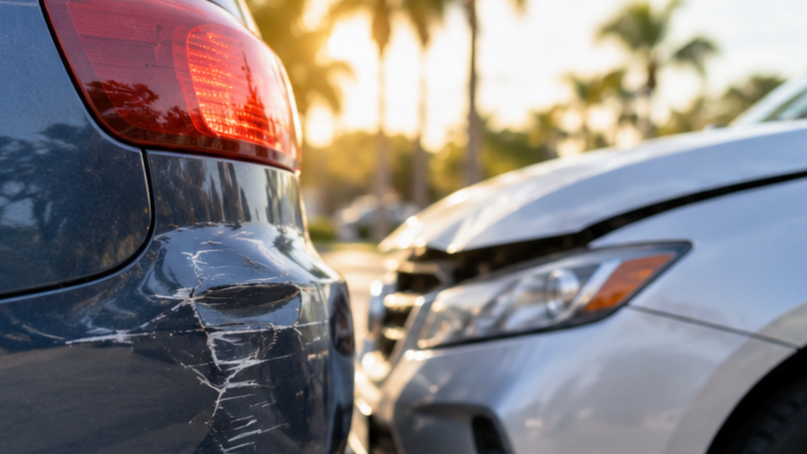
You have just been in a car accident. The initial shock is beginning to wear off, but you are still trying to figure out what you need to do next. The vehicles are damaged, but both still run. No one appears to need an ambulance, and the other driver suggests exchanging insurance information and leaving.
Now you are wondering: Do you have to call the police?
Beginning October 1, 2026, Florida is changing one part of that answer. The amount of apparent property damage that triggers the requirement to immediately report a crash to law enforcement is increasing from $500 to $2,000.
But the new threshold applies only to property damage. Crashes involving injury or death still trigger separate reporting requirements, and Florida law separately requires a written report within 10 days for a crash resulting in property damage that does not require a law-enforcement report.
Understanding those distinctions can help you know when police must be called, what the new $2,000 threshold actually means, and what to do if the damage or injuries are not obvious at the scene.
What Changes in Florida on October 1, 2026?
Florida law requires drivers to immediately notify the appropriate law enforcement agency when certain crashes occur.
For crashes occurring before October 1, 2026, the pre-amendment version of Florida Statute § 316.065 uses a $500 apparent-property-damage threshold.
Effective October 1, 2026, Senate Bill 488, Chapter 2026-39, increases that threshold to $2,000.
For crashes occurring on or after October 1, 2026, Florida drivers must immediately report a crash to law enforcement when it results in:
- Injury to any person
- Death of any person
- Apparent damage to a vehicle or other property of at least $2,000
If the crash occurs within a municipality, notice goes to the local police department. Otherwise, the statute directs drivers to the county sheriff or nearest Florida Highway Patrol office.
If a crash causes vehicle or property damage but does not require a law-enforcement report, Florida law separately requires the driver to submit a written crash report to the Florida Department of Highway Safety and Motor Vehicles within 10 days.
One word in Florida’s new $2,000 property-damage threshold is especially important: “apparent.”
You are making that assessment at the scene, before an auto body shop removes a bumper, examines sensors, checks the frame, or discovers damage that was not visible from the outside.
What If the Damage Looks Like Less Than $2,000?
The new rule does not require drivers to accurately calculate repair costs on the side of the road.
A bumper can look scratched while brackets, sensors, cameras, lighting equipment, or other components underneath have also been damaged. Damage that looks minor at the scene can cost considerably more to repair once the vehicle is inspected.
There is another important distinction: the amount of visible vehicle damage does not tell you whether someone has been injured.
After a collision, a person can experience neck pain, back pain, headaches, dizziness, or other symptoms even when the vehicles do not appear heavily damaged.
That is why the new $2,000 threshold should be understood for what it is: a property-damage reporting threshold, not a measure of whether someone was injured in the crash.
If Someone Is Hurt, the $2,000 Threshold Does Not Apply
The $2,000 figure does not replace Florida’s separate reporting rule for crashes involving injury or death.
Florida's reporting statute identifies those crashes independently from the property-damage threshold. That requirement remains in place under the amended law.
You do not need $2,000 in vehicle damage before an injury-related crash becomes reportable.
The difficulty is that you do not always know the full extent of an injury in the first few minutes after a collision. Some people feel pain immediately. Others notice symptoms after they have left the scene and had time to settle down.
If you are experiencing pain, discomfort, dizziness, confusion, numbness, or another concerning symptom after a crash, do not judge whether you need medical attention by how damaged the cars look.
Florida law also requires a law-enforcement officer investigating a crash to complete a long-form crash report in several situations, including when the crash involves personal injury or an indication that a driver or passenger is complaining of pain or discomfort.
What Can a Police Report Document After a Florida Car Accident?
A police report does not by itself determine who is legally responsible for a crash.
But having law enforcement respond can help document basic information while the accident scene is still fresh.
Depending on the circumstances, a crash report can identify the drivers and passengers, the vehicles involved, the location of the crash, witnesses, insurance information, and the investigating officer.
Florida law specifies much of the information that must be included in long-form and short-form crash reports. That record can become useful later if questions arise about who was involved, where the collision occurred, or who witnessed it.
Florida law also places limits on how certain crash reports and statements made for purposes of completing them can be used as evidence in court.
For an injured person, the practical point is simpler: a police response can create an official record of important identifying and scene information, but it does not replace your own photographs, witness information, or other evidence when you are able to gather it safely.
What Else Should You Document at the Scene?
If you are physically able to do so safely, gather information before everyone leaves.
Photograph the vehicles from several angles, including the visible damage and license plates. Take pictures of the roadway, traffic lights or signs, lane markings, debris, skid marks, and the broader accident scene when relevant.
Exchange identifying and insurance information with the other driver.
If someone witnessed what happened, ask for that person's name and contact information.
It can also help to write down what you remember while the details are fresh. A few hours later, something as simple as which lane each vehicle occupied or where the impact occurred can become harder to reconstruct.
Do not let documentation interfere with getting medical help. If you are injured, your health comes first.
What If You Left Without Calling Police and Later Realize You Are Hurt?
Do not assume that leaving the scene without calling law enforcement automatically ends a potential injury claim. The reporting requirements and the viability of an injury claim are separate questions, and whether you have a claim depends on much more than the existence of a police report.
Other evidence can help establish what happened, including photographs, video, witness testimony, vehicle damage, medical records, and communications involving the drivers or insurers.
If the crash involved vehicle or property damage but did not require a law-enforcement report, Florida law still requires the driver to submit a written crash report to the state within 10 days.
If symptoms appear or become more noticeable after you leave the scene, describe them accurately when you seek treatment. Medical records can document when you reported those symptoms, what your providers observed, what treatment was recommended, and how your condition progressed.
As both a Registered Nurse and an attorney who is Board Certified in Civil Trial Law by The Florida Bar, Maryann Furman brings a medical and legal perspective to reviewing those records, particularly when an insurer questions whether symptoms or treatment are related to the collision.
What Is the Practical Takeaway From Florida’s New $2,000 Rule?
Effective October 1, 2026, Florida’s new $2,000 threshold changes only the property-damage amount that triggers immediate notice to law enforcement.
For drivers, the difficult part is that the information available at the scene can be incomplete. The true cost of repairs might not be known yet, and the extent of an injury can become clearer after you leave.
The practical takeaway is to understand the $2,000 figure for what it is: a property-damage reporting threshold. It does not replace Florida's separate rules for crashes involving injuries or for written crash reports when law enforcement is not required to respond.
Questions After a Florida Car Accident? The Nurse Lawyer, P.A. Can Help
If you were injured in a Florida car accident, you may still have questions about what happened at the scene, whether the crash was properly reported, or what to do now that symptoms or insurance issues have developed.
At The Nurse Lawyer, P.A., we help injured clients understand how crash reporting, medical records, insurance issues, and other evidence can affect an injury claim based on the circumstances of the collision.
With offices in Palm Harbor, Tampa, and St. Augustine, we represent injured clients throughout Florida.
If you have questions after a Florida car accident, contact The Nurse Lawyer, P.A. to discuss your situation and learn more about your legal options.
Disclaimer: The articles on this blog are for informational purposes only and are no substitute for legal advice or an attorney-client relationship. If you are seeking legal advice, please contact The Nurse Lawyer, P.A. directly.